
Commercial LED Lights: Key Features And Applications For Business Spaces

Safety standards, certifications, and applications across commercial spaces
Compliance with safety and performance standards is part of commercial lighting specification. Certifications and listings (such as national electrical standards or third-party safety marks, where applicable in a jurisdiction) often address electrical safety, fire risk, and photobiological classifications. Specifiers may reference applicable standards for ingress protection, thermal performance, and electromagnetic compatibility. Emergency egress lighting and backup power requirements are typically governed by local building and life-safety codes and are incorporated into fixture selection where emergency performance is required.
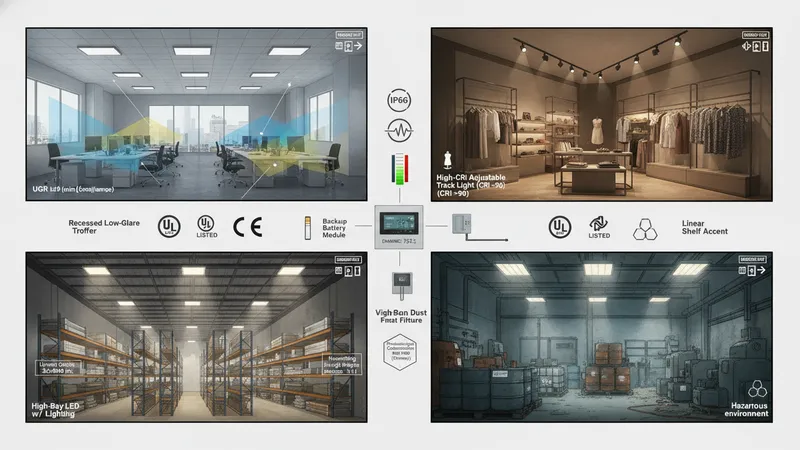
Applications vary by business type: offices commonly emphasize visual comfort and low-glare distributions; retail spaces focus on color fidelity and flexible accenting; warehouses prioritize high lumen density and aisle uniformity; industrial facilities may require ruggedized fixtures and ingress protection. In each case, designers assess the interplay of task requirements, fixtures introduced earlier (troffers, high-bays, linear systems), and control strategies. Case-specific environmental factors such as dust, chemicals, or vibration influence the selection of materials and mounting methods.
Documentation and testing play roles in ensuring compliance and performance. Photometric data (IES files), dimming behavior under specified control protocols, and warranty terms for electrical components are typically reviewed before procurement. For large projects, mock-ups or sample installations may be tested on-site to confirm both aesthetic and functional outcomes under real operating conditions. Such validation helps align expectations without implying a guaranteed result for every installation.
Overall, deploying LED systems in commercial settings involves assessing performance metrics, fixture mechanics, operational practices, and safety requirements in context. Stakeholders often balance competing priorities—visual needs, energy use, durability, and maintenance access—using project-specific data and documentation. Readers may find that systematic evaluation of these elements supports clearer planning and coordination across design, installation, and facilities management teams.