
Commercial LED Lights: Key Features And Applications For Business Spaces

Energy consumption, lighting controls, and operational considerations
Energy use is often quantified in terms of connected load (watts) and delivered illuminance per watt. Luminous efficacy (lumens per watt) provides a baseline for comparing sources but actual energy use depends on controls, operating hours, and end-use behavior. Daylight-responsive dimming, scheduling, and occupancy sensing can reduce energy consumption in many commercial settings by lowering output when full illumination is unnecessary. Savings estimates vary with building type and occupancy patterns; designers commonly model expected operating hours to project potential reductions rather than asserting fixed savings amounts.
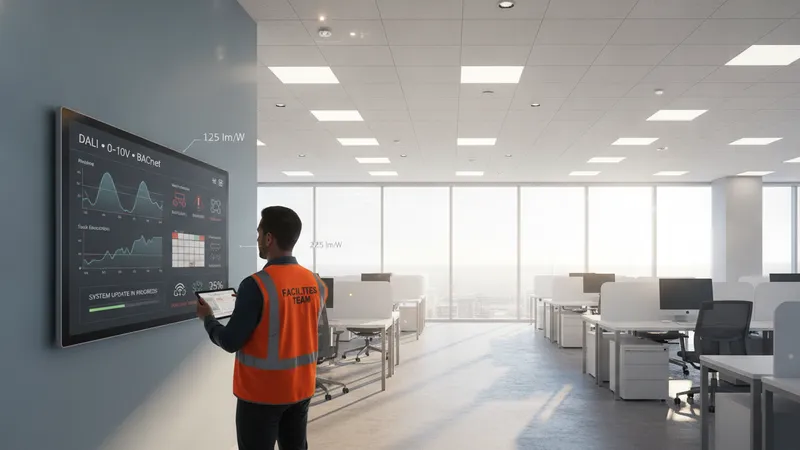
Control interoperability is an important operational consideration. Systems using standard protocols (e.g., 0–10V, DALI, or wireless standards) may allow integration with building management systems and remote monitoring. Centralized lighting management can support analytics such as runtime tracking and fault detection, which may assist maintenance planning. However, increased connectivity can add configuration complexity and may require periodic firmware or network maintenance as part of facility operations.
Operational factors include scheduled maintenance, replacement policies, and spare-parts strategies. Facilities often plan for driver and sensor replacement intervals and may stock commonly used components. Lifecycle planning might also consider phased retrofits, where initial capital constraints result in staged upgrades. Such approaches can spread installation impact over time while allowing incremental improvements in light quality and control sophistication.
When estimating total cost of ownership, practitioners typically account for energy consumption under expected usage profiles, routine maintenance labor, replacement parts, and potential downtime during servicing. Modeling tools and lighting calculators are frequently used to compare scenarios, and sensitivity analyses may be applied to understand how variations in operating hours or component lifespans affect projected outcomes. These analyses are intended as planning aids rather than absolute forecasts.