
Biomass Gasification Systems: How Thermochemical Conversion Produces Syngas For Energy

Gasification Stages and Thermochemical Reactions in Biomass Conversion
Gasification progresses through identifiable stages: drying, pyrolysis, oxidation (partial combustion), and reduction. During drying, free moisture is removed; pyrolysis thermally decomposes organic macromolecules into char, volatiles, tar, and gases. Oxidative reactions supply heat by partially combusting a fraction of the feedstock, establishing temperatures needed for endothermic reduction reactions that convert char and volatiles into syngas components. Key reduction pathways include the Boudouard reaction (C + CO2 ⇌ 2CO), water–gas reaction (C + H2O ⇌ CO + H2), and various reforming reactions that influence the relative amounts of H2 and CO in the product stream.
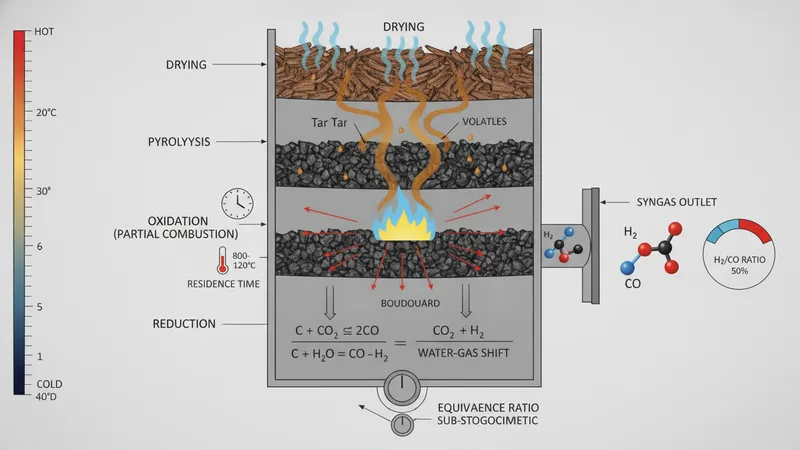
Temperature and residence time strongly affect the relative importance of these reactions. Lower-temperature regimes may yield higher tar and char, while higher temperatures can favor gas-phase reforming and tar cracking. Equivalence ratio, defined as the ratio of actual to stoichiometric oxidant, is often controlled in the range that allows partial oxidation without complete combustion; typical values vary by reactor and feedstock but are usually below the stoichiometric point for full combustion. These process levers may be adjusted to steer syngas composition toward greater hydrogen or carbon monoxide content depending on downstream needs.
Tar formation and cracking are significant operational concerns because tars can condense and foul downstream equipment. Tar yield is influenced by feedstock lignin content, heating rate, and temperature profile. Thermal cracking at elevated temperatures and catalytic reforming using catalysts such as dolomite or nickel-based materials may reduce tar levels but introduce cost and catalyst management considerations. Understanding the balance between thermal conditions and catalyst use is important for designing downstream gas cleaning and conditioning strategies appropriate for the intended application.
Operational tips include monitoring gas temperature profiles and using staged air or steam injection to manage hotspots and promote complete conversion of volatiles. Instrumentation for syngas composition, tar sampling, and particulate load can provide feedback for adaptive control strategies. Designers may also consider modular approaches that allow retrofit of additional cleanup or reforming units as syngas end-uses evolve. These practical measures often help align thermochemical behavior with reliability and maintainability expectations over a system’s operational lifetime.