
Air Pollution Monitors: How Sensors Track Particulate Matter And Gases

Applications, limitations, and integration of particulate and gas monitoring
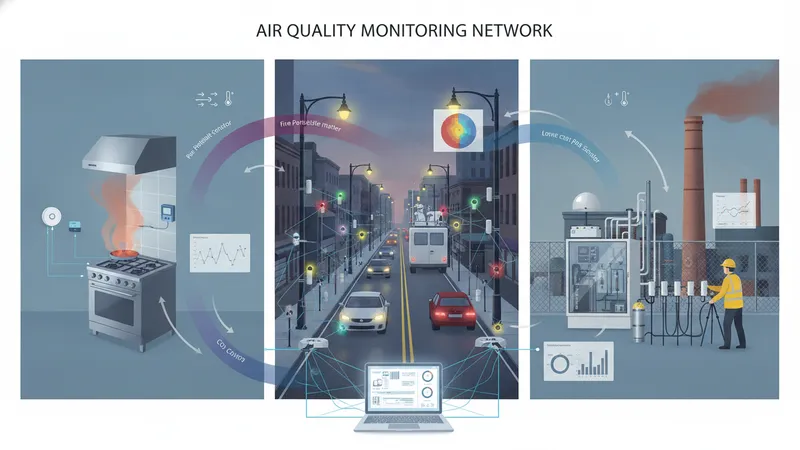
Monitoring systems are applied across indoor air quality assessments, urban ambient monitoring, industrial fence-line surveillance, and episodic event studies. Particle sensors can reveal diurnal patterns related to traffic, cooking, or heating, while gas sensors can identify combustion signatures, industrial releases, or ventilation issues. Integration of particle and gas data with meteorological variables enhances the ability to infer transport and likely sources. Applications differ in their required measurement fidelity; some use continuous, networked sensors to observe patterns, while others focus on periodic reference sampling for compliance or research rigor.
Limitations include sensor-specific interferences, environmental sensitivities, and the representativeness of point measurements for broader areas. Low-cost sensors often provide useful relative information but typically require calibration or comparison to reference methods for absolute quantification. Spatial variability in urban environments means that a single monitor may not capture neighborhood-level differences; dense sensor arrays or mobile monitoring campaigns can help map variability but require increased data management and calibration efforts to maintain comparability.
Integration strategies commonly combine continuous sensors for temporal resolution with periodic laboratory analyses for chemical speciation and mass-based reference points. Source apportionment methods, receptor models, and back-trajectory analyses can use combined datasets to suggest likely pollutant origins, though such analyses typically carry uncertainties and rely on complementary information. Cross-disciplinary collaboration among technicians, data scientists, and subject-matter experts can improve interpretation by aligning measurement design with analytic methods.
Overall, monitoring programs typically balance instrument selection, calibration rigor, and data-processing workflows to match objectives. Recognizing limitations, documenting methods, and applying conservative uncertainty estimates often strengthen the credibility of findings. Future sections could address emerging sensor developments and evolving best practices, but the present overview focuses on established measurement principles and practical considerations for particulate and gas monitoring.