
Sage Accounts Payable Automation: Understanding Key Features And Workflow Capabilities

Accounts payable automation feature categories and workflow components
Feature categories for accounts payable automation typically include capture and validation, routing and approvals, matching and exceptions, payment orchestration, and reporting. Capture and validation convert incoming invoices into structured data and may apply tax or vendor-code checks. Routing and approvals define who reviews and signs off, often using role-based access and thresholds. Matching and exceptions compare invoices to purchase orders and receipts to detect discrepancies. Payment orchestration controls scheduling and method selection, while reporting provides analytics on cycle times, outstanding liabilities, and performance indicators.
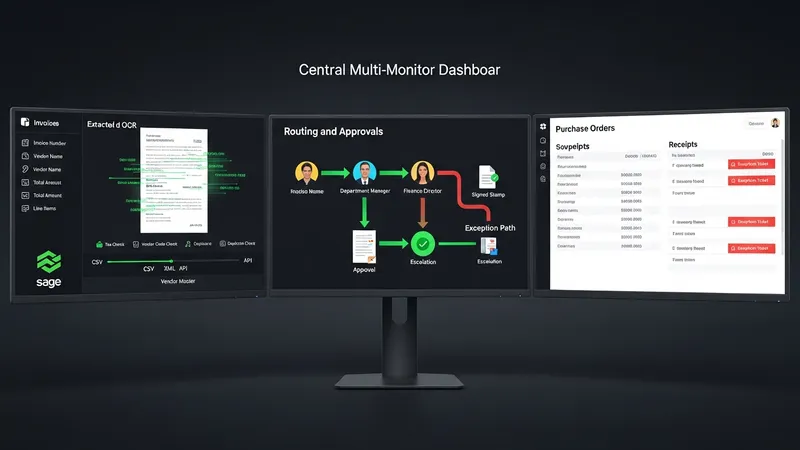
When mapping these categories to an existing Sage deployment, teams may assess connector capabilities such as API availability, file exchange formats, and vendor master synchronization. Capture tools may offer batch processing and vendor-specific templates that reduce manual correction needs. Workflow components often include configurable SLA markers and escalation rules that may be adjusted to align with internal policy. Each category interacts: for example, improved capture accuracy can reduce exception volume and shorten approval cycles.
Typical considerations for workflows include support for multi-entity accounting, currency handling, and multi-language invoices where relevant. Automation solutions may offer role hierarchies to enforce segregation of duties and to support audit requirements. It is common to define measurable targets—such as invoice processing time or percentage of invoices auto-matched—to monitor performance. Continuous monitoring often leads to incremental refinement of rules and routing to better match operational realities.
Security and access control are part of feature planning: solutions usually provide user authentication, permission sets, and activity logs. Backup and retention policies for invoice images and audit records are often set to comply with tax or regulatory retention requirements. During feature selection, teams may prioritize modular components that can be enabled progressively, allowing organizations to scale automation scope while managing implementation risk.