
Machine Learning Courses: Key Topics, Skills, And Learning Outcomes

Practical Projects, Evaluation, and Assessment related to Machine Learning Courses: Key Topics, Skills, and Learning Outcomes
Project-based assessments commonly require learners to apply a pipeline from raw data to evaluated model outputs, demonstrating understanding across multiple topics. Typical projects ask for problem definition, dataset description, preprocessing steps, model selection rationale, and evaluation results. Grading criteria often examine reproducibility, clarity of assumptions, and appropriate use of metrics rather than only final performance numbers. Projects may be structured to mirror typical workflow stages and to highlight trade-offs made during development.
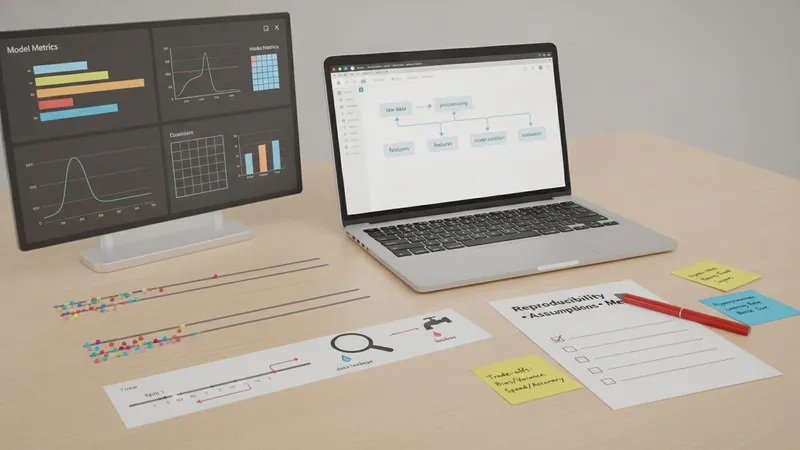
Evaluation practices taught in coursework may stress the importance of proper validation techniques to avoid optimistic estimates. Instructors often present cross-validation, stratified sampling for imbalanced labels, and temporal validation for time-series data as domain-relevant methods. The lessons commonly warn about data leakage—where information from validation sets influences training—and show how to design experiments to obtain more reliable estimates of out-of-sample behavior. Such evaluation topics are central to interpreting what a reported metric may actually imply.
Diagnostic tools and interpretability methods are frequently included to help learners understand model behavior beyond aggregate metrics. Techniques may include feature importance measures, partial dependence plots, confusion matrix analysis, and local explanation methods for individual predictions. Students typically practice using these tools to identify failure modes, bias patterns, or opportunities for incremental improvement. Coursework may frame these methods as investigative steps that supplement, rather than replace, quantitative evaluation.
Peer review and presentation elements are sometimes used to assess communication skills and reasoning. Students often prepare concise reports or poster-style summaries that describe dataset choices, modeling steps, and evaluation findings. Instructors may evaluate clarity of argumentation, transparency of methods, and the ability to contextualize results in relation to limitations. These communication-focused outcomes are intended to reflect how technical work is commonly shared and critiqued in applied settings.