
Cloud Security: Managing Data Protection, Privacy, And Compliance Risks

Encryption, key management, and data protection techniques in cloud environments
Encryption is a foundational technical control for protecting data in cloud storage and transit. Commonly, applications employ TLS for in-transit protection and symmetric encryption for at-rest data. Key management choices influence control and compliance: cloud-managed keys may reduce operational overhead, while customer-managed keys or hardware security modules can increase control over key lifecycle. Decisions typically consider regulatory requirements for key residency and the ability to produce key handling evidence for audits. Encryption alone does not eliminate access controls or monitoring needs but is an important component of layered defenses.
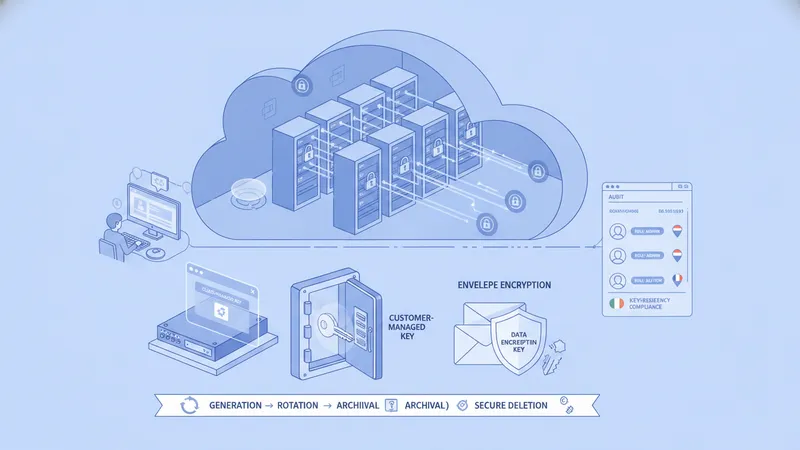
Key lifecycle management includes generation, rotation, archival, and secure deletion. Rotation policies often balance security needs against operational constraints, and some standards suggest routine rotation intervals while accounting for affected services. Access to key material usually requires strict role separation and logging to capture who accessed keys and when. When using envelope encryption, data encryption keys are themselves encrypted using master keys, which may help limit the scope of compromise and simplify key rotation strategies for large datasets.
Data masking, tokenization, and pseudonymization are techniques used to reduce exposure of sensitive elements while preserving utility for testing or analytics. Masking may replace values in non-production environments; tokenization replaces sensitive values with surrogate tokens bound in a token vault. Pseudonymization reduces identifiability by substituting identifiers; however, its effectiveness depends on context and the possibility of linkage attacks. These techniques may be combined with strict access controls and logging to meet privacy-oriented requirements without impeding legitimate processing.
Cryptographic controls should be complemented by operational safeguards such as secure backups, integrity checks, and well-defined key recovery procedures. Backup encryption and retention policies must align with deletion and legal hold requirements to prevent unintended exposure during restoration. Documentation of cryptographic choices and rationale can aid compliance demonstrations and support risk assessments. Teams often consider cryptographic agility—planning for algorithm or key changes—to reduce future migration burdens if standards evolve.